
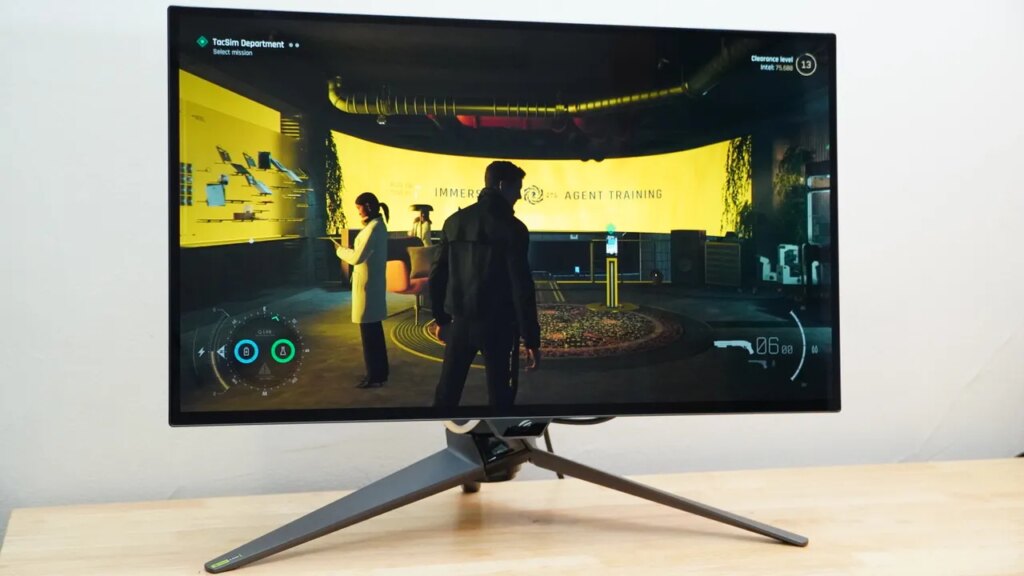
Asus already had one in all IGN’s favourite 4K gaming monitors on its arms with the Asus ROG Swift PG32UCDP, delivering a beautiful OLED panel that might render 4K video games at a zippy 240Hz or swap to 1080p for an excellent quicker 480Hz. It’s nonetheless a superb choice in the marketplace and made all of the extra inexpensive by its age. Now nearly two years on, Asus has the ROG Swift OLED PG27UCWM, a really comparable monitor with a smaller 27-inch panel that will get some new show tech for slight visible refinement. In fact, newer tends to imply costlier, and this mannequin is ready to come back in at $1,199, placing it nicely forward of different competing OLED shows like the sooner PG32UCDP, which was sitting at $859 on the time of writing, or the 1440p/500Hz MSI MAG 272QP QD-OLED X50 at $599. Let’s take a look at the way it stacks up.
Design and Options
Asus didn’t go away a lot out when it designed the ROG Swift OLED PG27UCWM. That stated, it doesn’t have audio system, however you’ll discover it checks packing containers in nearly each different division.

From the entrance, it seems to be like a reasonably tame, cleanly-built gaming monitor with maybe a little bit of a gaudy stand due to the angular, gamery aesthetic and the LED bat sign of the ROG emblem that it desires to splash onto your desktop day and night time (this may be turned off, fortunately). If you’d like, you’ll be able to swap for a VESA stand utilizing an included adapter. The supplied stand is a lot practical, although, providing the standard vary of changes you’ll discover on a high-end monitor. There’s additionally a slot within the neck of the stand for passing by means of cables, and the place some monitor stands make it fairly a squeeze to even get energy and a single HDMI cable by means of this portal, the PG27UCWM supplies loads of room for a number of cables.
The PG27UCWM is prepared for lots of cables, too. You’ll discover two HDMI 2.1 ports, a DisplayPort 2.1a port, and even a succesful USB-C port that’ll absorb video and ship out as much as 90 watts of energy. There are two USB ports for passing knowledge to a linked system, letting the monitor function a USB hub as nicely with a KVM swap so you’ll be able to cross that connection to the USB-C hyperlink or a separate USB-B hyperlink. If you wish to join audio system, there’s a headphone jack, too.
Round again, the PG27UCWM spices issues up slightly. Slightly than the basic black ABS plastic you’ll discover on half the screens on the planet, the PG27UCWM opts for a clear plastic that provides it one thing of a cyberpunk aesthetic. It might nonetheless really feel like low-cost plastic, but it surely seems to be rattling good.
One other characteristic is a presence sensor that may assist protect the lifespan of the OLED panel by dimming it everytime you step away. I didn’t discover it overly delicate, so I wasn’t involved it’d blink off whereas I’m in the midst of a recreation.
Adjusting settings within the monitor is simple with a joystick management for navigating menus and making picks. This sits simply behind the presence sensor on the backside fringe of the show.
Then there’s the show itself. The ROG Swift OLED PG27UCWM packs a 4K/240Hz show with HDR10 and Dolby Imaginative and prescient assist, variable refresh charges right down to 48Hz, and a setting that swaps the show to 1080p and cranks the max refresh charge as much as 480Hz.
The show is shiny, which might harm in a shiny room, but it surely has a good anti-reflection coating that not less than cuts down on how shiny reflections seem.
Testing
The Asus ROG Swift OLED PG27UCWM proves its value with sturdy efficiency in goal measurements. My colorimeter measured a large coloration gamut with 100% protection of sRGB, 89% protection of AdobeRGB, and 97% protection of DCI-P3 coloration areas. The monitor delivers the colour precisely with a mean dE1976 of 1.04 and a max of two.66, making this a stable choice for inventive work. The monitor achieved these ends in its default Racing image profile, however not all totally different settings will carry out as nicely. The Surroundings image profile, as an illustration, had a nasty coloration accuracy dE1976 common of over 10.
By default, the show ran a tame 147.6 nits that might be comfy in a modestly lit room, and that comes alongside infinite distinction due to 0.0-nit black ranges. This stage got here alongside an ordinary 2.2 gamma curve and a cushty 6600K whitepoint. Bumping the brightness stage to 100% raised the white stage to 249.7 nits.
HDR is a specialty for this show. It might not go extremely shiny for a full display in regular use, however it may well convey out extra gentle in HDR. I measured a 294.8-nit whitepoint for a full display and a 519-nit whitepoint for a ten% window with the remaining screenspace blacked out. That would go increased nonetheless for smaller highlights, however required switching the monitor to its Adjustable HDR setting and elevating the brightness to 100%. In these situations, I measured a 4% window at 1,066 nits and a 1% window at 1,172 nits. These excessive brightness ranges can sag shortly, however for non permanent, shiny bursts of HDR highlights, they’ll dazzle.
Movement readability can be distinctive. The monitor’s assist for a 240Hz refresh charge in 4K or 480Hz in 1080p mixed with the ultra-fast pixel response time of OLED retains particulars sharp in quick movement.
Gaming and Efficiency
The Asus ROG Swift OLED PG27UCWM’s panel is superb for each work and play. OLED panels had already been shifting away from troublesome sub-pixel layouts that might present coloration fringing on high-quality element and textual content or mainly anyplace with a pointy edge. With the PG27UCWM, Asus incorporates a panel with an RGB strip sub-pixel association, aligning with the sub-pixel association of your typical screens and thus avoiding the problem fully. Working in textual content paperwork, watching motion pictures, and taking part in video games, I by no means noticed the colour fringing that had impacted some earlier OLED show.
Even when it had the fringing, it may need been laborious to identify because the 4K panel is stunningly sharp on a 27-inch display. I didn’t discover myself pixel peeping. The display seems to be nice for motion pictures, that are sharp and actually play up the distinction and coloration the panel can present. In case you pair the monitor with the proper video supply, you’ll be able to even faucet into Dolby Imaginative and prescient.
Gaming simply makes issues all the higher. Attending to run at as much as 240Hz even at 4K makes the ROG Swift OLED PG27UCWM fairly the sight, and for extra aggressive or fast-paced video games, the choice to drop right down to 1080p and crank it as much as 480Hz can are available in clutch. I performed by means of a bit of Murderer’s Creed Shadows and loved the sharp element and potent distinction that brings the sport world to life sooner or later, and the following swapped over to 1080p so I may blitz by means of ranges in Hades 2 and energy by means of enemies in Trepang2. The monitor stored up with all the extraordinary motion and stored the main points extremely clear.
Switching modes can be easy. A single faucet on a devoted shortcut button switches between modes (a transparent on-screen indicator of this taking place can be useful, although).
The 1080p decision begins to harm slightly on the 27-inch panel, however you actually solely must swap over if you end up taking part in one thing that requires greater than 240fps, and in these instances, the pixels will typically be shifting too quick to note them individually.
Mark Knapp is a contributing freelancer for IGN protecting every part electronics and gaming {hardware}. He has over 10 years of expertise within the tech trade with bylines at PCMag, Reviewed, CNET, and extra. Discover Mark on Twitter @Techn0Mark or BlueSky at @Techn0Mark.

Hi, I’m Rishab. I’m a passionate pc gamer and an avid video game content writer. I have been involved with video games for over 2 decades now, and even today, after playing an astronomical number of games over the years, I’m still eager for more. In my free time, you will find me enjoying a hot cup of coffee and playing my favorite relaxing fishing game, Dave the Diver.