Ever pulled out the Parcheesi board and then spent ten minutes arguing about the rules? You’re not alone. Parcheesi looks simple. But the moment someone rolls a double or lands on your pawn, the questions start.
Good news. This guide clears it all up.
Parcheesi is one of the oldest and most loved board games out there. It’s easy to learn, fun for the whole family, and just tricky enough to keep things exciting. All you need is a board, some pawns, two dice, and a few friends.
By the end of this guide, you’ll know exactly how to set up the game, move your pawns, block your opponents, and race your way home. We’ll walk you through every rule step by step, in plain, simple language. No confusing jargon. No skipped steps.
So whether you’re playing Parcheesi for the first time or want to sharpen your strategy, you’re in the right place. Let’s get started.
What Is Parcheesi?
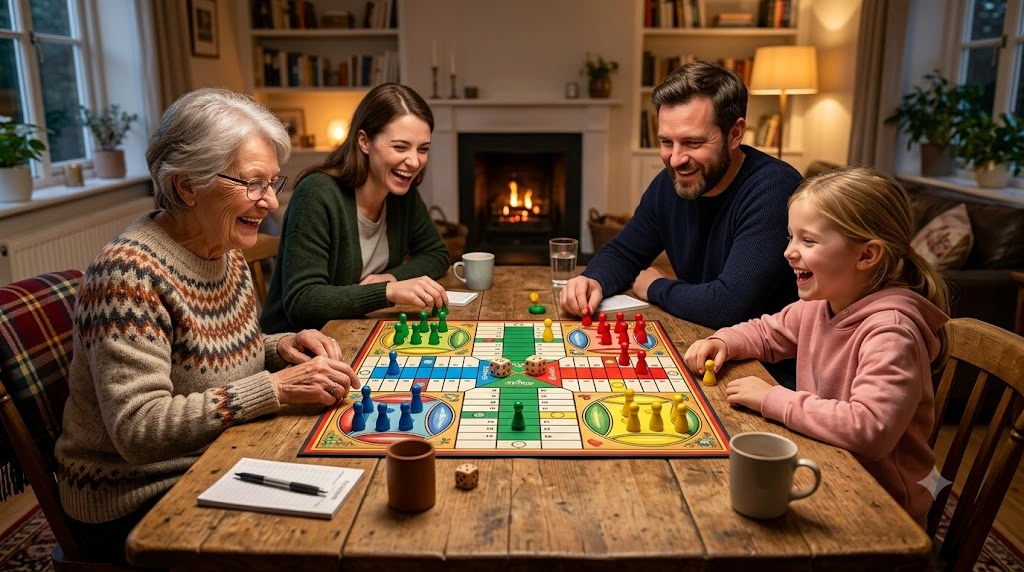
Parcheesi is a classic board game for two to four players. Each player picks a color and gets four pawns. The goal is simple: move all four of your pawns around the board and into the center home space before anyone else does.
That’s it. That’s the whole idea. Roll the dice, move your pawns, and race to the finish.
Parcheesi isn’t a brand new game either. It’s based on Pachisi, an ancient game from India that’s been played for centuries. Over time, it made its way to America and got a new name, a new board design, and a few tweaks to the rules. But the heart of the game stayed the same.
So why do people still love it today? A few reasons. It’s easy to pick up, even if you’ve never played before. It brings some real strategy into the mix, thanks to blockades and captures. And it’s a game the whole family can play together, from kids to grandparents. That mix of simplicity and strategy is exactly why Parcheesi has stuck around this long.
Also Read: How To Find and Use Treasure Maps In Minecraft!
The History of Parcheesi
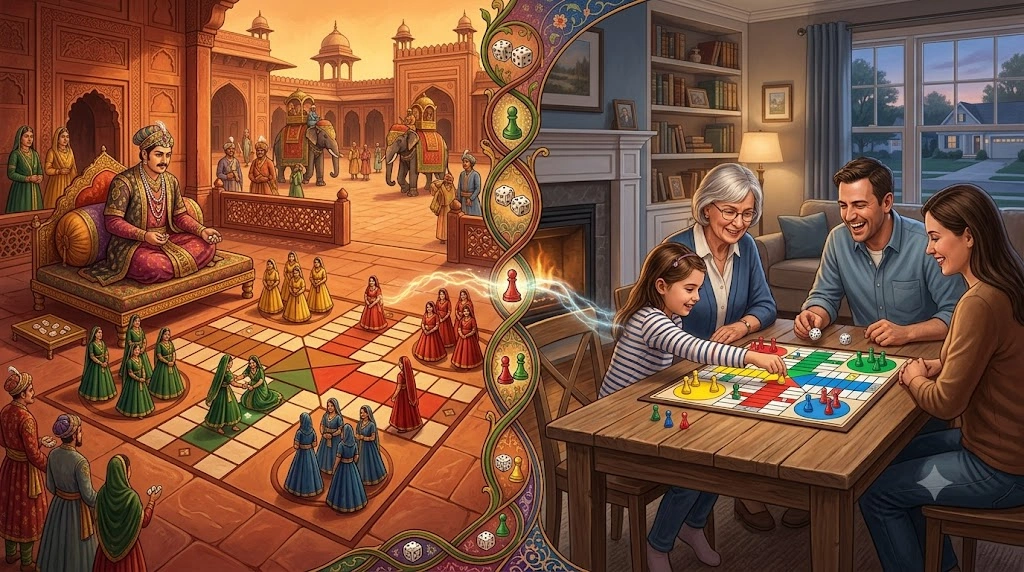
The Origins of Parcheesi: To understand Parcheesi, you have to go back a few hundred years to India. That’s where the original game, Pachisi, was born, sometime around the 16th century.
Pachisi wasn’t just a game people played on a table. Legend says the Mughal emperor Akbar the Great was such a fan that he turned his own palace courtyard into a giant Pachisi board. And instead of plastic pawns, real people, dressed in colorful clothes, moved across the squares to entertain him. Cowrie shells were used instead of dice to decide the moves.
Over time, Pachisi spread beyond royal courtyards and became a game ordinary families could enjoy at home. As it traveled to different parts of the world, it picked up new names, new boards, and small rule changes along the way. That’s how it eventually became the Parcheesi we know today, a version made popular in America with a fixed 68-space board, four starting nests, and the classic two-dice setup.
How Parcheesi Became Popular
Parcheesi really took off once it got commercialized. Companies like Selchow and Righter helped turn it into a proper packaged board game, complete with printed rules, a standard board design, and mass production. That made it easy for any household to grab a copy and start playing.
From there, it spread fast across the United States. Families loved it because it struck the perfect balance. Simple enough for kids to understand, yet strategic enough to keep adults hooked. It wasn’t long before Parcheesi became a staple of family game nights.
Its popularity didn’t stop at the U.S. border either. Variations of the game, like Ludo in the UK and other Pachisi-based games across the world, kept the spirit of the original alive in different cultures. Even today, Parcheesi holds its place as one of the most recognized and loved board games worldwide, proof that a game rooted in centuries-old tradition can still bring people together at the table.
Also Read: The Sims 5 System Requirements for PC
What You Need to Play Parcheesi
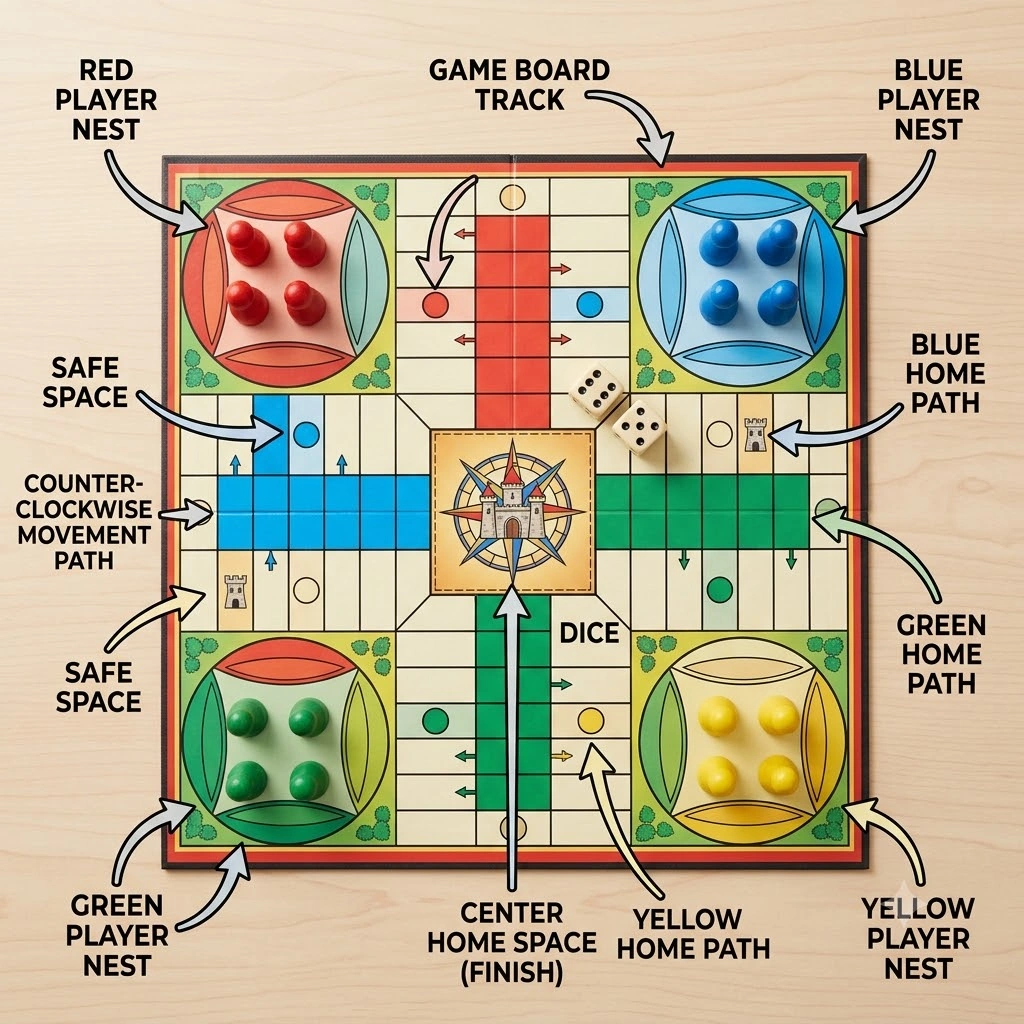
Game Components
Before you start playing, let’s look at what’s actually inside a Parcheesi set.
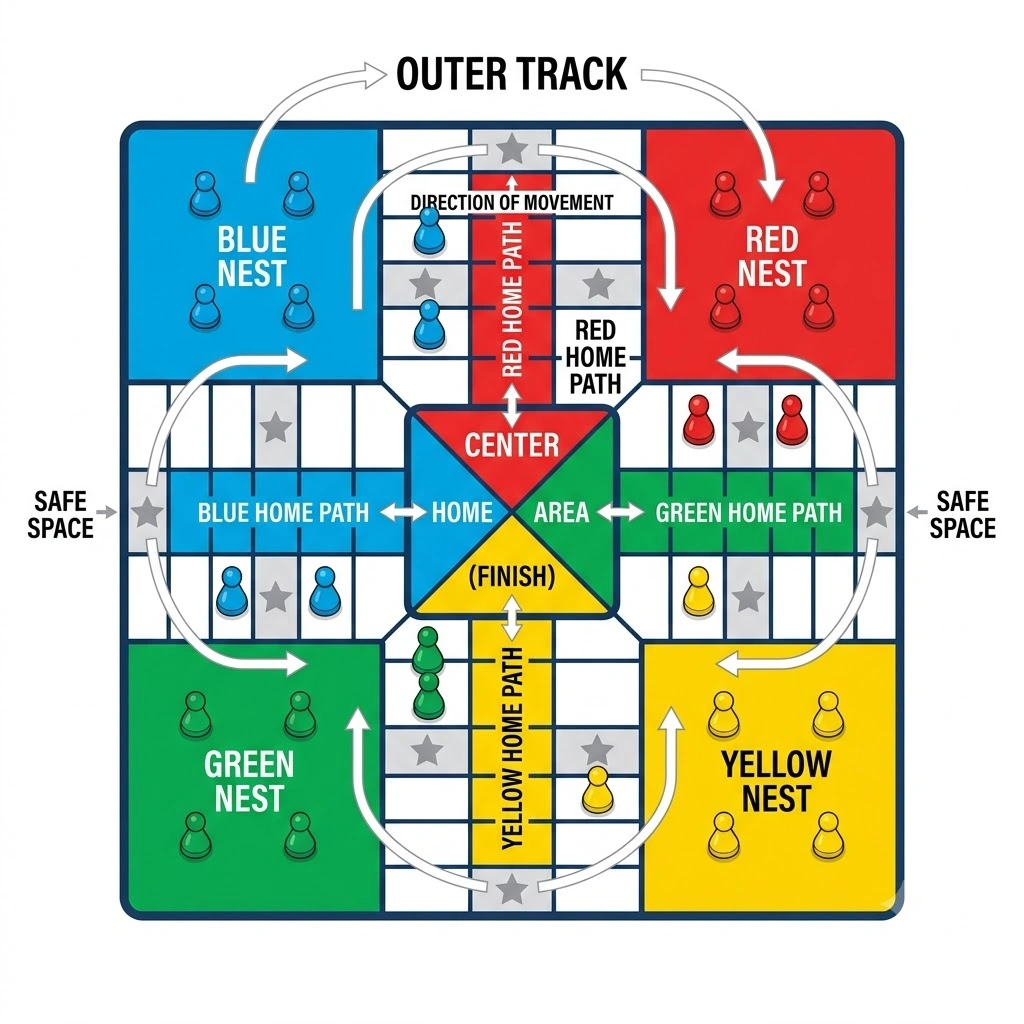
- The board. The board has a track running around the outside, with four corners set aside for each player’s nest, or starting area. Most American boards have 68 spaces going around the edge. Twelve of these are marked as safe spaces, usually shown with a small circle in the center. Pawns sitting on a safe space can’t be captured.
- The pawns. You get 16 pawns in total, four each in four colors, usually red, yellow, blue, and green. Every player picks one color and controls all four of those pawns.
- The dice. Parcheesi is played with two dice. You’ll roll them every turn to decide how far your pawns move.
- The home path. Each player also has their own home path, a private strip of colored spaces leading from the main track into the center. Once your pawn makes it around the board, it turns onto this path and heads for home. Only your own pawns can use your home path. Opponents can’t enter it.
- Players. The game works best with two to four players, each with their own color, nest, and home path.
Game Setup
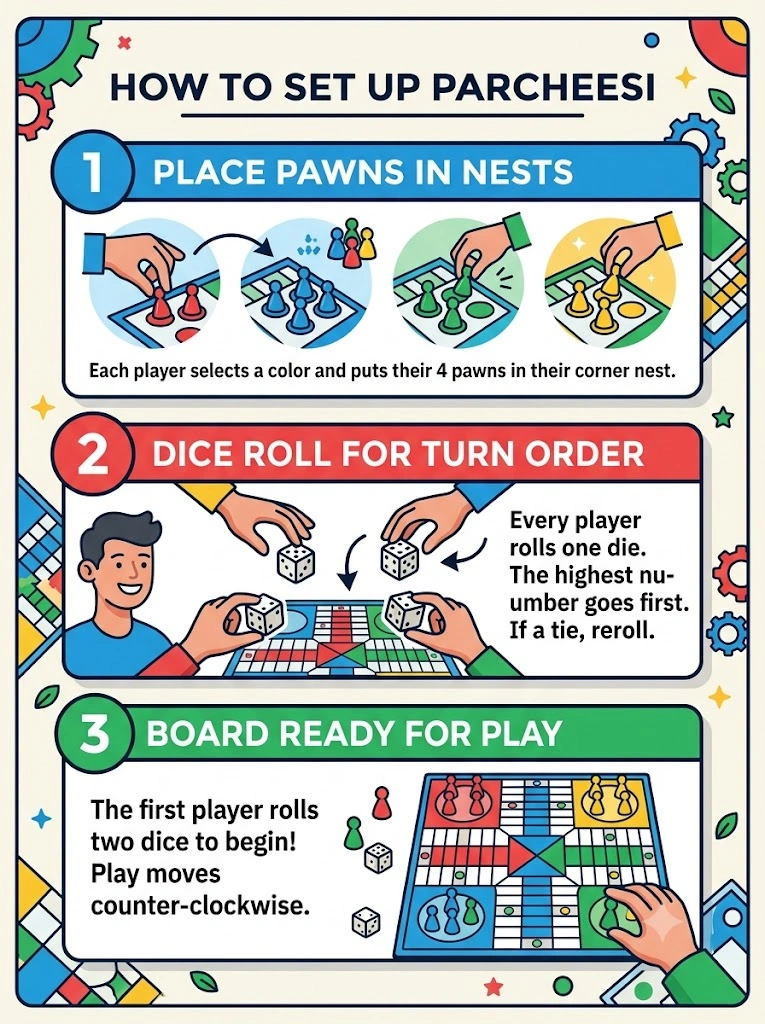
Getting the board ready is quick and simple.
Step 1: Place your pawns. Every player starts by putting their four pawns in their matching colored nest. If you’re playing green, all four green pawns go in the green nest, and so on.
Step 2: Decide who goes first. Each player rolls one die. Whoever rolls the lowest number gets to go first. After that, turns move around the table in order, usually counter-clockwise.
Step 3: Get ready to enter. Your pawns won’t move right away. They need to come out of the nest first, and that only happens once you roll a 5. We’ll cover exactly how that works in the next section.
Once everyone’s set up, you’re ready to roll the dice and start the race to home.
Also Read: 10 Best Games Like The Forest To Play (Ultimate 2026 List)
Parcheesi Rules Explained
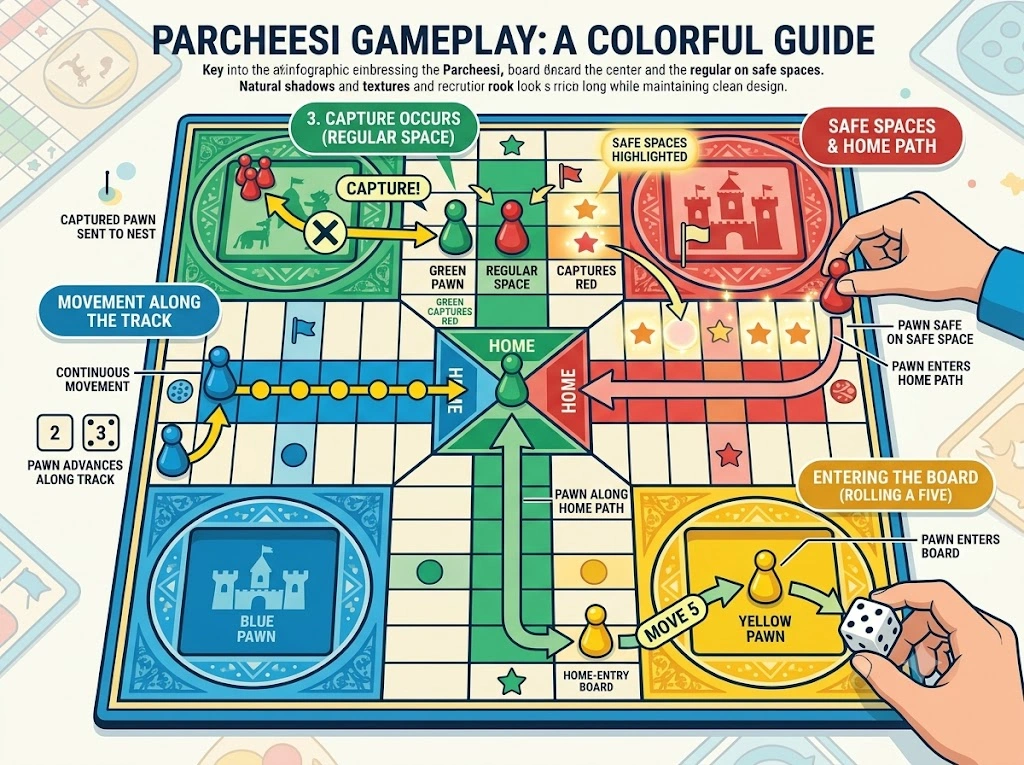
Starting the Game
- Your pawns can’t just walk onto the board whenever you like. They need a special roll to get started.
- To bring a pawn out of the nest, you need to roll a 5. This can be a 5 on either die, or the two dice adding up to 5. So if you roll a 3 and a 2, that also counts, since 3 plus 2 equals 5.
- Once you roll a 5, move one pawn from your nest to the Enter space right next to it. If your roll used both dice to make the 5, that’s your whole turn used up. But if you rolled a straight 5 on one die and something else on the other, use the leftover number to move a pawn forward.
- Here’s a tip for the early turns. You must bring a pawn out whenever you roll a 5, so don’t expect to save that roll for later. Keep rolling until all four of your pawns make it onto the board.
Moving Around the Board
- Once your pawns are out, the real game begins.
- On your turn, roll both dice and move your pawns forward. You have two options. You can move one pawn by the total of both dice, or you can split the numbers and move two different pawns.
- For example, if you roll a 4 and a 3, you could move one pawn 7 spaces total, or move one pawn 4 spaces and another pawn 3 spaces. Just remember, you can’t mix and match the numbers freely. If you roll a 5 and a 3, you move exactly 5 and exactly 3, not some other combination that adds up to 8.
- Rolling doubles is a nice bonus. If both dice show the same number, move your pawns as usual, then roll again. Keep rolling as long as you keep getting doubles. But watch out. If you roll doubles three times in a row, you have to send your pawn closest to home back to the nest.
- Once all four of your pawns are on the board, doubles get even better. You get to use all four numbers, the tops and bottoms of both dice, which always add up to 14. You can spread those 14 spaces across your pawns however you like.
Capturing Opponents
This is where Parcheesi gets competitive.
- If your pawn lands on a space occupied by an opponent’s pawn, you capture it. Their pawn goes straight back to their nest, and they have to start that pawn’s journey all over again. As a reward, you get to move one of your pawns forward an extra 20 spaces.
- There’s a catch, though. Captures don’t work everywhere. Safe spaces protect pawns from capture. So if an opponent’s pawn is sitting on one of those marked spaces, you can’t land on it and send it home. Pawns already on their home path are also protected. You can’t touch them there.
- One more thing to know. Two pawns of the same color can share a space and form a blockade. Once that happens, no other pawn, not even your own, can pass through or capture on that space until the blockade breaks.
Winning the Game
The finish line works a bit differently than the rest of the board.
- To win, you need to move all four of your pawns into the center home space. But you can’t just get close. You need the exact number on the dice to land your pawn precisely on home. Roll too high, and that pawn can’t move that turn.
- Every time you successfully bring a pawn home, you get a reward too. You can move one of your other pawns forward an extra 10 spaces.
- The first player to get all four pawns safely home wins the game. Simple goal, but as you’ve seen, getting there takes a mix of luck, timing, and smart moves.
How to Play Parcheesi (Example Gameplay)
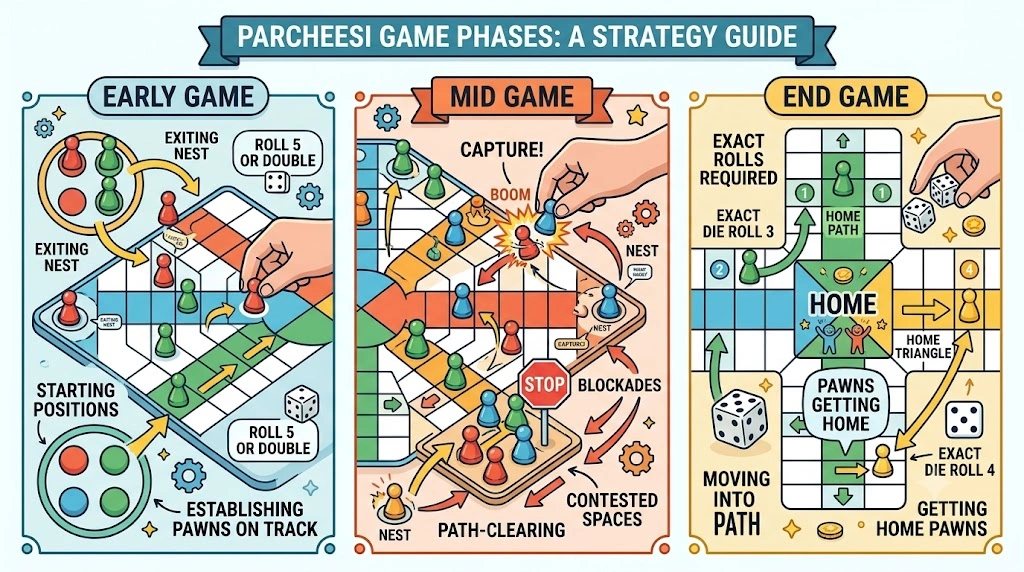
Let’s walk through what a real game might look like. This will help you see the rules in action, not just on paper.
Early Game
The early game is all about getting your pawns out and onto the board.
Here’s what usually happens in the first few turns:
- You wait for a 5. Every player is rolling dice, hoping to hit that 5 to bring a pawn out. Some players get lucky right away. Others wait a few turns.
- You bring pawns out one by one. Each time you roll a 5, a new pawn joins the board. Your goal in this phase is simple: get as many pawns out as you can.
- You start making small moves. With leftover dice numbers, you inch your pawns forward. There’s no need to rush. Early moves are mostly about positioning.
A common decision here is whether to spread your pawns out or keep them close together. Spreading out gives you more chances to capture opponents. Keeping pawns together sets you up for an early blockade.
Most players don’t have a fixed strategy this early. It’s more about reacting to your rolls and watching what your opponents are doing.
Mid Game
This is where the game really opens up. By now, most players have all four pawns on the board, and every turn matters more.
The mid game is a balancing act between two things: playing offense and playing defense.
On offense, you’re looking for chances to capture opponents. Watch for pawns sitting on unsafe spaces near your own pawns. A well-timed capture sends an opponent back to their nest and gives you a 20-space bonus. That’s a huge swing in your favor.
On defense, you’re trying to protect your own pawns. A few ways to do this:
- Move pawns onto safe spaces whenever possible.
- Use blockades to block opponents from passing.
- Avoid leaving a single pawn exposed right in front of an opponent’s likely roll.
Positioning multiple pawns wisely is key here. Try not to bunch all your pawns in one spot, since that limits your options. At the same time, keeping two pawns close enough to form a blockade when needed can slow down opponents chasing you.
A good mid-game player is always asking two questions before every move: Can I capture someone right now? And are any of my pawns in danger?
End Game
The end game is all about getting your pawns home safely, and this is where careful play really pays off.
A few strategies to keep in mind:
- Prioritize pawns closest to home. Focus your moves on pawns that are almost done with their journey. The closer they get, the more valuable they become.
- Watch your dice math. Remember, you need the exact number to enter home. If a pawn needs a 3 to get home, don’t waste a roll of 3 moving a different pawn if you can help it.
- Use your bonus moves wisely. Every pawn you bring home gives you a 10-space bonus. Save that bonus for a pawn that’s close to home too, so you can keep the chain going.
- Stay alert for late captures. Even near the finish line, opponents can still capture your pawns if they’re not on safe spaces or the home path. Don’t get careless.
Now, a few common mistakes players make in the endgame:
- Rushing pawns forward without checking the exact number needed. This leaves pawns stuck just outside home for turns at a time.
- Ignoring vulnerable pawns because you’re focused on your leading pawn. One bad roll from an opponent can send you right back to the nest.
- Breaking a blockade too early. Sometimes holding a blockade a little longer buys you the time you need to bring other pawns home safely.
Play it smart in this final stretch, and you’ll turn a close game into a clear win.
Best Parcheesi Strategies
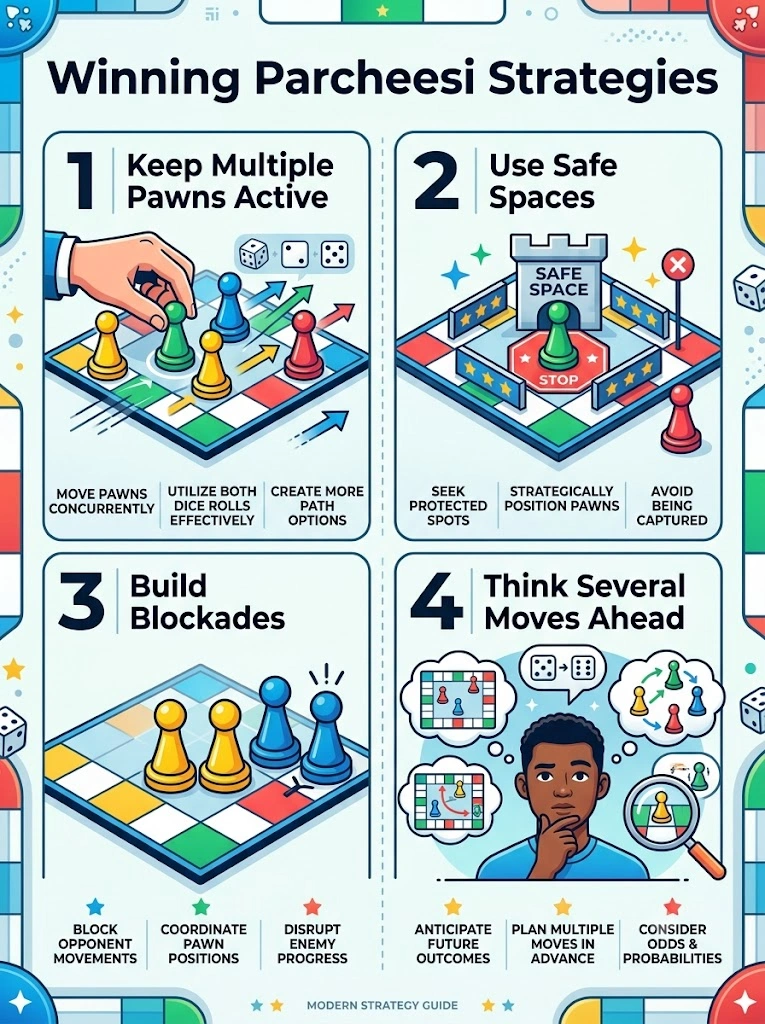
Once you know the rules, the next step is playing smart. Here are some tried and tested strategies to help you win more often.
Play With Multiple Pawns
A common beginner mistake is putting all your energy into one pawn while the other three sit back in the nest or barely move.
This isn’t a great approach. Here’s why:
- One pawn means one target. If your only active pawn gets captured, you lose all that progress in one shot.
- Multiple pawns give you options. With three or four pawns out, you can choose the best move every turn instead of being forced into one.
- You control more of the board. Spread out pawns let you set up captures, block opponents, and react to whatever your dice roll gives you.
Try to get all four pawns onto the board as early as you can, then move them forward at a fairly even pace. This way, you’re never stuck with just one option on your turn.
Use Safe Spaces Wisely
Safe spaces are your best friend in Parcheesi, and smart players use them all the time.
A safe space protects your pawn from being captured, no matter which opponent lands on it. That makes these spots incredibly valuable, especially when things get risky.
Here’s when to lean on them:
- When you’re being chased. If an opponent’s pawn is a few spaces behind you and could capture you, aim for the nearest safe space instead of running further ahead.
- When you have a pawn that’s far ahead of the rest, parking your lead pawn on a safe space protects your progress while you bring your other pawns up to speed.
- When multiple opponents are close by. The more pawns nearby, the higher your risk. Safe spaces neutralize that risk completely.
Staying on a safe space for a turn or two isn’t wasted time. It’s often the smarter move compared to pushing forward and taking a risky capture.
Build Blockades
Blockades are one of the most powerful tools in Parcheesi, and beginners often underuse them.
A blockade happens when two of your own pawns land on the same space. Once that happens, no other pawn, not even yours, can pass through that space. It’s like putting up a wall on the board.
Blockades are useful when:
- You want to slow down a chasing opponent. A blockade placed right in their path stops them cold.
- You need to protect a section of the board. If several opponents are trying to pass through one area, a blockade shuts the door on all of them at once.
- You’re not ready to move those two pawns forward. Sometimes holding position is better than pushing ahead into danger.
That said, don’t hold a blockade forever. Break it when:
- You need those pawns moving again to make progress.
- Holding it is no longer blocking anyone useful.
- You have no other legal move and are forced to.
Used at the right time, a blockade can completely change the flow of the game in your favor.
Think Ahead
The best Parcheesi players aren’t just reacting to their current roll. They’re thinking a few turns ahead.
Before making a move, ask yourself:
- What happens after this move? Will your pawn be exposed to a capture next turn? Would a different pawn placement be safer?
- What are my opponents likely to do? Watch their pawn positions and dice patterns. If they’re close to home, they may play more cautiously. If they’re behind, expect aggressive moves.
- Is this the right time to take a risk? Sometimes pushing a pawn into a risky spot is worth it for the chance to capture an opponent. Other times, playing it safe is the smarter call.
Balancing risk and reward is really the heart of Parcheesi strategy. Playing too cautiously can slow you down and cost you the game. Playing too aggressively can leave your pawns exposed again and again.
The players who win consistently are the ones who read the board, think a few steps ahead, and adjust their strategy as the game unfolds.
Common Mistakes Beginners Make
Everyone makes mistakes when they’re new to Parcheesi. That’s completely normal. Here are the most common ones, so you can spot them early and avoid them.
- Focusing on one pawn. It’s tempting to rush one pawn all the way home first. But this leaves your other three pawns stuck in the nest, doing nothing. Try to bring all your pawns out and move them together.
- Ignoring safe spaces. New players often forget safe spaces even exist. They keep pushing pawns forward without a second thought, right into an opponent’s path. Always check if a safe space is within reach before you move.
- Taking unnecessary risks. Not every move needs to be bold. Sometimes beginners chase a capture even when it leaves their own pawn exposed right after. Think about what happens after your move, not just during it.
- Breaking blockades too early. A blockade takes effort to set up, so don’t give it up too soon. Some players break theirs the moment they get a good roll, without thinking about whether it’s still useful.
- Forgetting to watch opponents’ moves. It’s easy to get caught up in your own pawns and ignore what everyone else is doing. But Parcheesi is a game about everyone’s pawns, not just yours. Keep an eye on where opponents are and what they might do next.
The good news? These mistakes are easy to fix once you know about them. A little awareness goes a long way in this game.
Parcheesi vs. Ludo
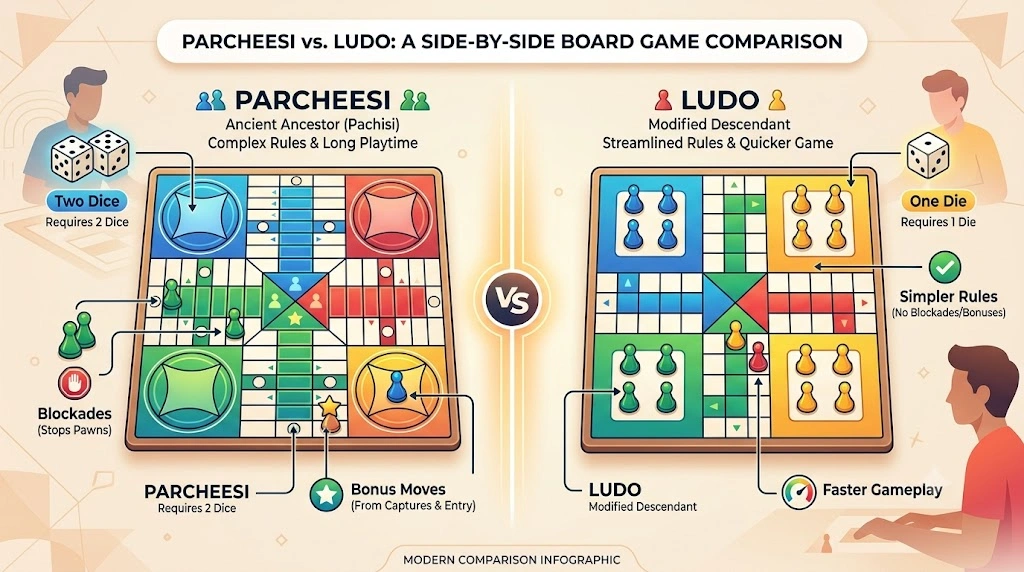
Parcheesi and Ludo often get mixed up, and it’s easy to see why. They look alike, they feel alike, and they share the same roots. But they’re not the same game.
Similarities
Both games come from the same ancient family tree, starting with Pachisi from India. Because of that shared history, they have a lot in common.
- Both use a cross-shaped board with a track around the outside.
- Both give each player four pawns of one color.
- Both require players to roll a specific number to bring pawns out of their starting area.
- Both involve racing your pawns around the board and into a home space.
- Both let you capture opponents by landing on their pawns.
If you already know how to play one, picking up the other is pretty easy.
Key Differences
Despite the similarities, a few key differences set these games apart.
FeatureParcheesiLudo
Dice used Two dice One die
Entering the board Needs a roll of 5 Needs a roll of 6
Blockades Common and important to strategy Less emphasized, rules vary by version
Board design Slightly bigger, American style layout Simpler, more traditional layout
Bonus moves Extra 20 spaces for captures, 10 for reaching home Usually just an extra turn on a 6
Because Parcheesi uses two dice, there’s more math and more decision-making on every turn. Ludo tends to be a bit simpler and faster, which makes it popular for quick games.
Which One Should You Play?
It really comes down to what you’re looking for.
- New to board games or playing with young kids? Ludo is a great starting point. The single die keeps things simple, and the games move fast.
- Want a bit more strategy and longer gameplay? Parcheesi is the better pick. The two-dice system opens up more choices, and blockades add a real strategic layer.
- Playing with a mixed group of kids and adults? Either game works well, but Parcheesi tends to keep older players more engaged thanks to its extra depth.
Honestly, you can’t go wrong with either. Many families end up loving both, just for different occasions.
Also Read: How to Play Ludo: The Complete Beginner’s Guide
Benefits of Playing Parcheesi
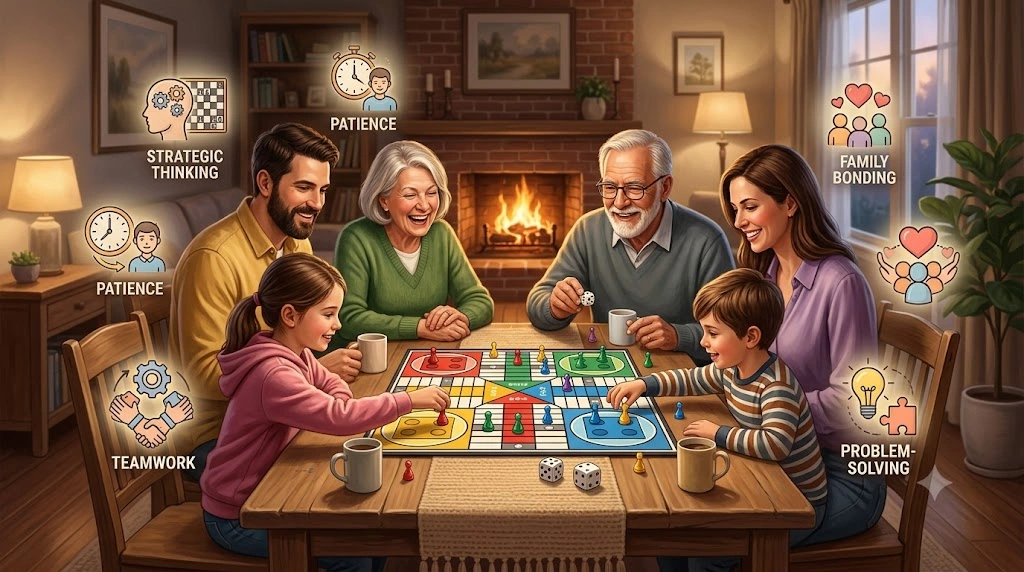
Parcheesi isn’t just fun. It’s actually good for you too. Here’s what you gain every time you sit down for a game.
- Improves strategic thinking. Every turn asks you to make a choice. Move which pawn? Take the risk or play it safe? Build a blockade or push forward? This kind of decision-making sharpens your strategic thinking over time.
- Encourages patience and planning. Parcheesi rewards players who think ahead instead of rushing. You learn to wait for the right moment, plan your next few moves, and stay calm even when the dice don’t go your way.
- Great family activity. Few games bring a family together quite like Parcheesi. It’s the kind of game that gets everyone around the same table, talking, laughing, and competing in a friendly way.
- Suitable for players of all ages. From young kids just learning to count, to grandparents who’ve played for decades, Parcheesi welcomes everyone. The rules are simple enough for beginners, yet deep enough to keep experienced players interested.
Few games manage to be this simple and this rewarding at the same time.
Frequently Asked Questions
Is Parcheesi the same as Pachisi? Not exactly. Parcheesi is based on Pachisi, an ancient Indian game. Over time, it was adapted and commercialized into the version played in America today, with its own board design and rule tweaks.
How many players can play? Parcheesi is designed for two to four players. Each player gets their own color and set of four pawns.
How long does a game take? A typical game takes anywhere from 30 minutes to an hour, depending on how many players are involved and how the dice rolls go.
What happens when you roll doubles? Rolling doubles lets you move your pawns and then roll again. If you roll doubles three times in a row, your pawn closest to home gets sent back to the nest.
Can you play Parcheesi online? Yes. Several websites and apps let you play Parcheesi online, either against friends or random opponents, using the same core rules as the physical board game.
Is Parcheesi good for kids? Definitely, it’s easy enough for kids to learn quickly, while still teaching them counting, planning, and turn-taking in a fun way.
Final Thoughts
Parcheesi might look like just another board game at first glance. But once you start playing, you’ll see there’s real strategy hiding behind those simple rules.
Let’s recap what you’ve learned. You now know how to set up the board, bring your pawns out, move around the track, and capture opponents along the way. You’ve picked up strategies like using safe spaces, building blockades, and playing with multiple pawns instead of just one. And you know exactly what it takes to get all four pawns home and win.
That’s really all it takes to go from beginner to confident player.
So the next time game night rolls around, pull out that Parcheesi board with confidence. You know the rules, you know the strategies, and you’re ready to play. It’s easy to learn, but as you’ll quickly find out, it takes a bit of practice to master it truly. Go ahead and give it a try. For more gaming article visit Indian Gaming Community!

Hi, I’m Rishab. I’m a passionate pc gamer and an avid video game content writer. I have been involved with video games for over 2 decades now, and even today, after playing an astronomical number of games over the years, I’m still eager for more. In my free time, you will find me enjoying a hot cup of coffee and playing my favorite relaxing fishing game, Dave the Diver.